
Do You Actually Need a Mold Contractor?
Often you do not, and we would rather tell you that than sell you something. The EPA states that if the moldy area is less than about 10 square feet, roughly a three foot by three foot patch, in most cases a homeowner can handle the job themselves, and Louisiana exempts a residential property owner doing mold work on their own property from licensure altogether. What decides it is not the size of the patch on its own, it is whether you know where the water is arriving from.
Already know you need someone out? Call (315) 640-3590.
Deciding whether this one is yours to handle
Measure the area you can see
You, with a tapeUnder about 10 square feet, roughly three feet by three feet, the EPA says a homeowner can in most cases handle the cleanup. Over it, the federal guidance stops backing you.
Name the water
YouA known spill, an overflow or a window left open is a cause you can close. If you cannot say where the water came from, stop here: cleaning a surface fed by an unknown source buys a few months.
Read the humidity in the worst month
You, with a hygrometerEPA says 30 to 60 percent, CDC says no higher than 50 percent. A reading stuck above that with the air conditioning running is a mechanical or building problem rather than a cleaning one.
Check what is on the room side of the exterior wall
You, with a flashlightVinyl wallcovering, oil-based paint, poly sheet or faced batt turned toward the room. Any of these on an exterior wall here is a probable cause, and removing the wrong-side barrier is a real repair.
Work out how long it has been wet
YouThe EPA's window is 24 to 48 hours. Material wet for longer, or repeatedly, is a removal decision rather than a drying one, and porous material often has to leave the building.
Buy the assessment, not the removal, if you are still unsure
An assessorThe cheapest useful purchase is moisture readings and a written extent, from a firm that is not selling you the removal. Louisiana requires that separation above $7,500 and it is the right order at any price.
Work down the list. The first answer that stops you is the point at which somebody else should look, and plenty of people never reach it.
The 10 square foot line, and the state exemption behind it
The EPA advises that if the moldy area is less than about 10 square feet, less than roughly a three foot by three foot patch, in most cases a homeowner can handle the job themselves. That is a federal size below which you are not expected to hire anybody, and it is worth knowing because it stops a small patch being sold to you as a project. Louisiana agrees from the other direction: R.S. 37:2157(A)(17) exempts a residential property owner who performs mold remediation on his own property from licensure entirely, and extends the same exemption to a tenant, or a managing agent or employee of either, working on property they own or lease. Nothing in state law stands between you and a bucket. Above roughly 10 square feet the federal guidance stops backing a do-it-yourself job, which is the point to take seriously rather than the point at which to panic.
Two federal agencies say you probably do not need testing
This is where most of the money wasted on mold in this market goes. Where growth is visible, EPA guidance says that in most cases a sample adds nothing. It also states that since no EPA or other federal limits have been set for mold or mold spores, sampling cannot be used to check a building's compliance with federal standards, which means a spore count has no published pass mark to be measured against. The CDC's position is shorter: it does not recommend mold testing. So if you can see it, you do not need a laboratory to tell you it is there, and a report built mainly on laboratory numbers is presenting a judgment as though it were a standard. The money is better spent tracing where the moisture comes from. If somebody is selling you an assessment, ask what the moisture investigation consists of before you ask what the testing consists of.
A hygrometer settles most arguments in this city
It is the cheapest instrument in this field and it answers the question people spend hundreds of dollars circling. The EPA advises reducing indoor humidity to between 30 and 60 percent, and the CDC advises keeping it as low as you can, no higher than 50 percent, all day long. Put the meter in the room that smells and read it in August rather than January, because the indoor number drifts up any time the air conditioning is off. If the reading sits comfortably under 50 with the system running, the air in that room is not the problem and you should be looking for a leak. If it will not come down below 60 with the system running, you have a mechanical or a ventilation problem and no amount of cleaning a wall will touch it. Either way you have learned something that a photograph of a stain cannot tell you.
Things worth doing yourself that are real repairs here
Some of the most effective work in this climate is unskilled and cheap. The LSU AgCenter's position is that the interior side of a wall should be as permeable as possible, which rules out vinyl wallpaper, oil-based interior paints and an interior vapor barrier on insulation, and it adds the line worth acting on: having no vapor barrier on the interior side matters more than having a retarder on the outside, and none is preferable to one on the wrong side. So stripping vinyl wallcovering off an exterior wall is a genuine repair in New Orleans, not redecorating. Two more from the EPA. Reduce the potential for condensation on cold surfaces such as windows, piping, exterior walls, roofs and floors by adding insulation, which warms the surface when you cannot dry the air. And do not install carpeting where there is a perpetual moisture problem, or on concrete floors subject to leaks or frequent condensation, which names the standard slab floor in half this metro.
What not to buy: spraying is not remediation
The EPA states that the use of a chemical or biocide that kills organisms such as mold, chlorine bleach for example, is not recommended as a routine practice during mold cleanup. It also states that there is no practical way to remove every mold spore from an indoor space, and that the way to control indoor mold growth is to control moisture. Those two sentences rule out a whole category of purchase. Anything sold as treating your air, fogging a room or killing what is there, with no removal of material and no work on the water, is not what the federal guidance describes. If a quote is mostly chemical application, the question to ask is what happens to the wet material and what happens to the source, and if the answer is nothing, the work will need doing again.
When it stops being a job you should do yourself
Four situations, and they are about the water rather than the mold. First, when it has been wet longer than the window: the EPA's line is that material dried within 24 to 48 hours will in most cases not grow mold, and past that it becomes a removal decision, with absorbent or porous materials such as ceiling tiles and carpet often having to be thrown away. Second, when you cannot reach the wet material, which is most of this metro's housing: on a raised pier and beam house the condensation happens under the floor, and on a slab the plumbing is cast into the concrete and the stain shows a foot from the break, so neither can be read from the visible growth. Third, when it keeps coming back, which means the source is still running. Fourth, when it is well over 10 square feet. In those cases the thing to buy is not removal, it is somebody finding the water.
When the smell has been there for months and there is nothing to see
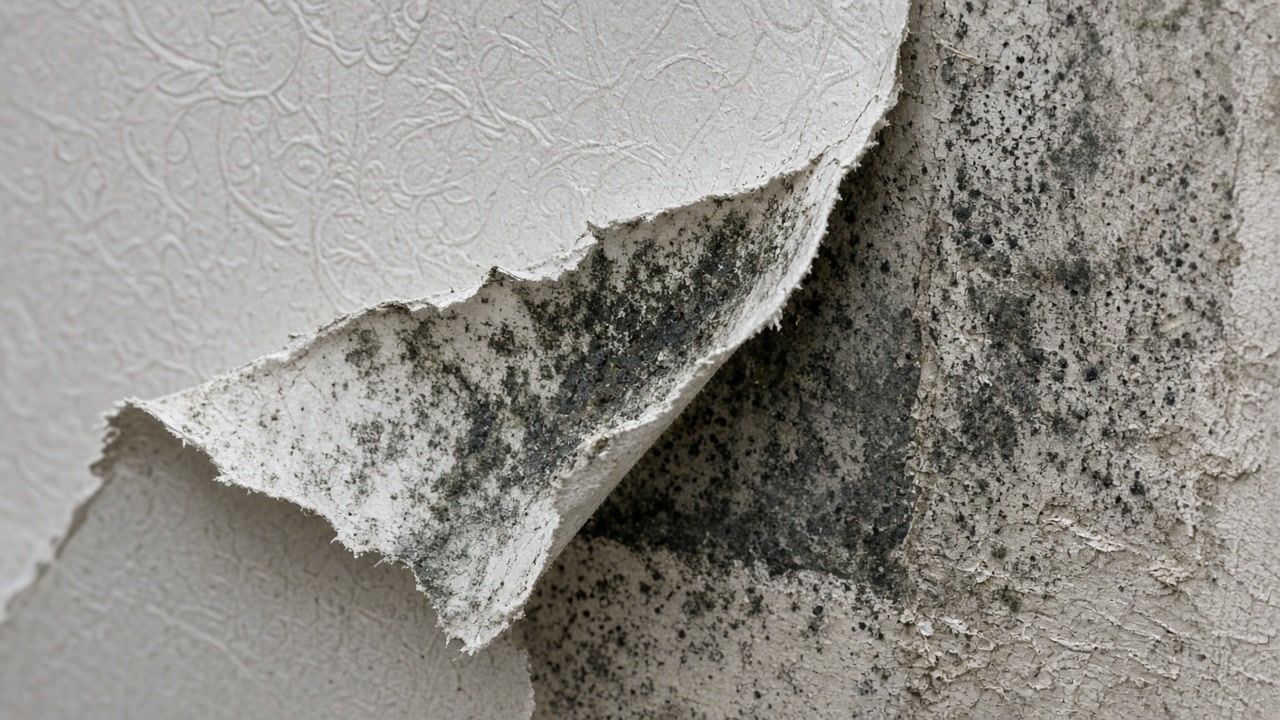
This is the signature case in New Orleans and it is the one most likely to be misdiagnosed as a roof or a pipe. Because the condensation forms on the interior side of a low-permeance layer, the growth sits on the back of the wallpaper, the back of the drywall or the cavity side of the insulation, so a homeowner smells it for months and then one day finds a stain that appears to have no source. The source is the room's own air conditioning. NOAA's normals put the mean dew point at 75.2F in July and 75.1F in August, at or above the temperature a cooled house holds its walls at, and four finishes turn the wall into the place where that water lands. You cannot settle this one yourself with a bucket, and you also should not let anyone settle it by chasing the roof. A small inspection square cut where the moisture readings point will answer it in an afternoon.
One thing not to do, even though everyone recommends it
Do not open the windows to dry a room out in summer. This is the most common piece of advice given here and in this climate it is backwards. The EPA's target is indoor relative humidity below 60 percent. NOAA's normals for this station put mean relative humidity at 76 percent for the year and 88 percent at 6am, with a July mean dew point of 75.2F, and air at a 75.2F dew point is already saturated at 75F. There is no hour of a summer day when outdoor air will bring a room in this city below the EPA number. Airing it out imports water rather than removing it, and it is worst in the morning when the instinct is strongest. Close the house, run the air conditioning, add a dehumidifier, and measure the result rather than guessing at it.
If you do hire someone, the three things to check first
Check the name on the quote against the board's Contractor Search, which is free, takes a contractor name, license number, city, parish or qualifying party, and returns only currently active licenses. Ask who is doing the assessment and who is doing the removal, because R.S. 37:2158(A)(19)(c) makes it a violation for a mold remediation contractor to perform both on the same property, and (d) closes the two-companies-one-owner version, though both duties only attach above seven thousand five hundred dollars in labor and materials. And ask for the written report: above that figure it is a legal duty under (a), and the statute also makes it a violation to render false, deceptive, misleading or unfounded opinions, so an alarming verbal finding with nothing behind it is a named problem in this state rather than merely a sales technique.
What we do, and when it is worth involving us
We arrange the work rather than perform it, and we arrange it in the order the law in this state requires: the assessment with one firm, the removal with another, separately owned, because R.S. 37:2158(A)(19)(c) and (d) bar one entity or one owner from doing both on a property above the threshold. We keep to that below the threshold too, where nothing requires it, because an opinion about how much has to come out should not be written by the people paid to take it out. If you have read this far and concluded the job is yours, good, that is the right outcome and it costs you nothing. If the area is large, if you cannot find the water, if it has come back, or if what you are describing is a smell with no visible source in a cooled house in August, tell us what you are seeing and we will arrange for somebody to find the water and put the findings in writing.
Sources used in this guide
The EPA advises that if the moldy area is less than about 10 square feet, less than roughly a three foot by three foot patch, in most cases a homeowner can handle the job themselves.
Source: United States Environmental Protection Agency, accessed 2026-09-22
Louisiana R.S. 37:2157(A)(17) exempts from mold remediation licensure a residential property owner who performs mold remediation on his own property, and an owner or tenant, or a managing agent or employee of an owner or tenant, who performs mold remediation on property owned or leased by the owner or tenant, with that exemption not applying if the managing agent or employee engages in the business of performing mold remediation for the public.
Source: Louisiana State Licensing Board for Contractors, Contractors Licensing Law and Rules and Regulations, effective August 1, 2022, accessed 2026-09-22
Where mold growth can already be seen, EPA guidance says sampling is in most cases unnecessary.
Source: United States Environmental Protection Agency, accessed 2026-09-22
The CDC states that it does not recommend mold testing.
Source: Centers for Disease Control and Prevention, About Mold, accessed 2026-09-22
The EPA states that since no EPA or other federal limits have been set for mold or mold spores, sampling cannot be used to check a building's compliance with federal mold standards.
Source: United States Environmental Protection Agency, accessed 2026-09-22
The EPA advises reducing indoor humidity to between 30 and 60 percent to decrease mold growth, by venting bathrooms, dryers and other moisture-generating sources to the outside, using air conditioners and dehumidifiers, increasing ventilation, and using exhaust fans when cooking, dishwashing and cleaning.
Source: United States Environmental Protection Agency, accessed 2026-09-22
The CDC advises keeping humidity levels in your home as low as you can, no higher than 50 percent, all day long.
Source: Centers for Disease Control and Prevention, About Mold, accessed 2026-09-22
The EPA states that the use of a chemical or biocide that kills organisms such as mold, chlorine bleach for example, is not recommended as a routine practice during mold cleanup.
Source: United States Environmental Protection Agency, accessed 2026-09-22
The EPA states that there is no practical way to remove every mold spore from an indoor space, and that the way to control indoor mold growth is to control moisture.
Source: United States Environmental Protection Agency, accessed 2026-09-22
The EPA states that wet or damp building materials and furnishings should be cleaned and dried within 24 to 48 hours to prevent mold growth, and that if wet or damp materials or areas are dried 24 to 48 hours after a leak or spill happens, in most cases mold will not grow.
Source: United States Environmental Protection Agency, accessed 2026-09-22
The EPA states that absorbent or porous materials such as ceiling tiles and carpet may have to be thrown away if they become moldy.
Source: United States Environmental Protection Agency, accessed 2026-09-22
The EPA advises that in areas where there is a perpetual moisture problem carpeting should not be installed, and advises against installing carpeting on concrete floors subject to leaks or frequent condensation.
Source: United States Environmental Protection Agency, accessed 2026-09-22
The EPA advises preventing condensation by reducing the potential for condensation on cold surfaces such as windows, piping, exterior walls, roof or floors by adding insulation.
Source: United States Environmental Protection Agency, accessed 2026-09-22
The LSU AgCenter states that having no vapor barrier on the interior side is more important than having a vapor retarder on the outside, and that none is preferable to one on the wrong side.
Source: LSU AgCenter, Bill Robinson and Claudette H. Reichel, Ideal Wall Assemblies for Hot-humid and Mixed-humid Climates, accessed 2026-09-22
The LSU AgCenter states that any moisture that gets in a wall must be able to dry to the inside, that the interior side of the wall should be as permeable as possible, and lists what that rules out: no vinyl wallpaper, no oil-based interior paints and no interior vapor barrier on insulation.
Source: LSU AgCenter, Bill Robinson and Claudette H. Reichel, Ideal Wall Assemblies for Hot-humid and Mixed-humid Climates, accessed 2026-09-22
Four things become the condensing plane on an exterior wall in this climate, and all four are on the federal and university lists of what not to do in a warm-humid zone: vinyl wallpaper, which the Building America Solution Center classes at 0.1 perm or less; oil-based interior paint, which the LSU AgCenter names; polyethylene sheet on the interior face of the studs; and foil-faced or kraft-faced batt insulation installed with the facing toward the room.
Source: Pacific Northwest National Laboratory, U.S. Department of Energy Building America Solution Center, accessed 2026-09-22
Because the condensation forms on the interior side of a low-permeance layer, the growth sits on the back of the wallpaper, the back of the drywall or the cavity side of the insulation. The Building America Solution Center describes exactly this: water vapor migrating inward condenses on the cool, impermeable surface with no way to dry to the interior.
Source: Pacific Northwest National Laboratory, U.S. Department of Energy Building America Solution Center, accessed 2026-09-22
The NOAA thirty year normals for 1991 to 2020 at the New Orleans airport station put the mean dew point at 75.2F in July and 75.1F in August. Dew point is the temperature at which the air in question starts giving up its water, so on the average July day the outdoor air here will condense on any surface held below about 75F.
Source: NOAA National Centers for Environmental Information, 2023 Local Climatological Data Annual Summary with Comparative Data, NEW ORLEANS, LOUISIANA (KMSY), WBAN 12916, accessed 2026-09-22
The EPA advises drying wet materials within 24 to 48 hours. In New Orleans the outdoor air in that window carries a mean dew point of 75.2F in July and 75.1F in August, with mean relative humidity of 88 percent at 6am, so outdoor air brought into a wet building in summer adds water rather than removing it.
Source: NOAA National Centers for Environmental Information, 2023 Local Climatological Data Annual Summary with Comparative Data, NEW ORLEANS, LOUISIANA (KMSY), WBAN 12916, accessed 2026-09-22
Mean relative humidity at the New Orleans airport station is 76 percent for the year, and by hour of the day it is 88 percent at 06 LST and 63 percent at 12 LST.
Source: NOAA National Centers for Environmental Information, 2023 Local Climatological Data Annual Summary with Comparative Data, NEW ORLEANS, LOUISIANA (KMSY), WBAN 12916, accessed 2026-09-22
This metro carries both foundation types on the same streets. Raised pier and beam construction with an open or vented space underneath dominates the pre-war stock and much of what has been rebuilt since, because federal rule 44 CFR 60.3(c)(2) requires the lowest floor to sit at or above the base flood level. Slab on grade dominates the post-war suburbs, where the American Community Survey puts the median year built at 1972 in Metairie, 1976 in Terrytown and 1978 in Kenner and Chalmette.
Source: Office of the Federal Register, Electronic Code of Federal Regulations, Title 44 Section 60.3, accessed 2026-09-22
The Building America Solution Center states that during warm seasons in humid climates the outside air can contain more water vapor than the air within the crawl space, and that rather than helping to dry out a crawl space, the vents can actually encourage condensation in the crawl space by allowing warm, humid air to enter and condense on the floor joists, which are likely to be cooler, especially if the rooms above are air conditioned.
Source: Pacific Northwest National Laboratory, U.S. Department of Energy Building America Solution Center, accessed 2026-09-22
The board publishes a free public contractor search that can be queried by contractor name, license number, city, parish, type of contractor and qualifying party, and returns only contractors whose license or registration is currently active. The page carries the board's own caution that the information is provided as a courtesy and may not reflect recent changes or updates.
Source: Louisiana State Licensing Board for Contractors, contractor search, accessed 2026-09-22
Louisiana R.S. 37:2158(A)(19)(c) makes it a violation for a mold remediation contractor to perform both mold assessment and mold remediation on the same property.
Source: Louisiana State Licensing Board for Contractors, Contractors Licensing Law and Rules and Regulations, effective August 1, 2022, accessed 2026-09-22
Louisiana R.S. 37:2150.1(11) defines the regulated person by the size of the job: a mold remediation contractor means any person who engages in removal, cleaning, sanitizing, demolition, or other treatment, including preventative activities, of mold or mold-contaminated matter that was not purposely grown at that location and where the costs for such labor and materials exceed seven thousand five hundred dollars. Mold remediation applies only to the regulation of mold-related activities that affect indoor air quality and does not apply to routine cleaning when not conducted for the purpose of mold-related activities intended to affect indoor air quality.
Source: Louisiana State Licensing Board for Contractors, Contractors Licensing Law and Rules and Regulations, effective August 1, 2022, accessed 2026-09-22
Louisiana R.S. 37:2158(A)(19)(a) makes it a violation for a mold remediation contractor to fail to provide a written report to each person for whom he performs such services for compensation.
Source: Louisiana State Licensing Board for Contractors, Contractors Licensing Law and Rules and Regulations, effective August 1, 2022, accessed 2026-09-22
Louisiana R.S. 37:2158(A)(19)(b) makes it a violation for a mold remediation contractor to render, submit, subscribe, or verify false, deceptive, misleading, or unfounded opinions or reports.
Source: Louisiana State Licensing Board for Contractors, Contractors Licensing Law and Rules and Regulations, effective August 1, 2022, accessed 2026-09-22
Because Louisiana R.S. 37:2158(A)(19)(c) and (d) bar one entity, and any commonly owned entity, from performing both the assessment and the remediation on a property, an arrangement that routed both halves of a job above $7,500 to the same firm, or to two firms under one owner, would put that contractor in violation of the state licensing statute.
Source: Louisiana State Licensing Board for Contractors, Contractors Licensing Law and Rules and Regulations, effective August 1, 2022, accessed 2026-09-22
Services this guide relates to
Need someone to look at it?
Send the details and we will come back to you.