
New Orleans, the surrounding parishes, and the North Shore towns across Lake Pontchartrain
Mold Assessment and Moisture Survey in New Orleans
Find out where the water is arriving, whether the wall is leaking or condensing, and whether there is a mold job here at all, in writing, from a company that is not the one selling you the removal.
Mold Assessment quote
Tell us what you can see or smell, which room it is in, whether the house is raised or on a slab, and whether it is worse in summer. Those four narrow it further than the size of the patch does, because they point at how the water is arriving rather than where it ended up.
Would you rather talk it through? Call (315) 640-3590.
$100 off your first job
Credited by us on your first booked job.
- One credit per customer per property, on your first booked job.
- Valid through December 31, 2026.
Mention this offer when you book. Full terms.
The written verdict, and what sits behind every line of it
What you get is a verdict in writing: the rooms affected, the wet material, where the water is arriving from, what stopping it involves, and what putting the room back would take, with dated moisture readings and photographs behind every line. Where the water comes from is the whole question here, and it is the one a flashlight will not settle, because in this metro the water often does not arrive through anything at all. The NOAA thirty year normals for the airport put the mean dew point at 75.2F in July and 75.1F in August, at or above the temperature a cooled house holds its walls at, so on an average summer day moisture condenses out of the air onto the inside face of an exterior wall and the air conditioning is what made that surface cold enough. People here describe it exactly right when they say the wall is sweating. Put anything on the room side of that wall that water vapor cannot pass through, vinyl wallcovering most of all, and the growth lands on the back of it where nobody looks. So the survey is bought on its own, and in Louisiana that is not merely good practice. R.S. 37:2158(A)(19)(c) makes it a violation for a mold remediation contractor to perform both mold assessment and mold remediation on the same property, and subsection (d) closes the two-firm version of the same thing. Whoever eventually opens a wall in your house is somebody else, which is what makes the finding worth reading.
- A room by room walkthrough logging the growth, the staining, the corner the smell is strongest in, and what is on the walls, because vinyl wallcovering or oil-based paint on an exterior wall is a suspect before any pipe is
- Reading the building before the room: raised on piers over an open or vented space, or slab on grade, since the two fail in ways that share almost no symptoms
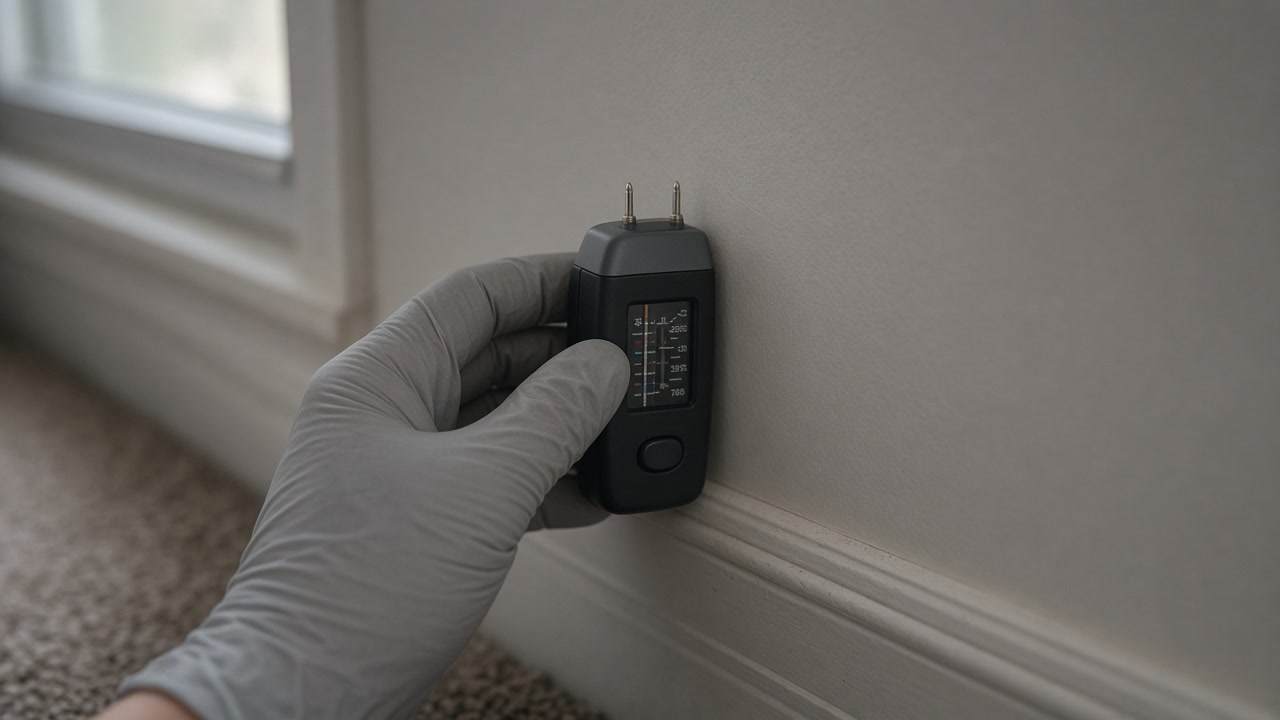
- Moisture meter and thermal imaging sweeps for wet material behind drywall and wallcovering, under flooring, and in the bottom plate where a wall meets a slab
- Surface temperature and dew point taken together, which is the only reliable way to tell a wall that is leaking from a wall that is sweating
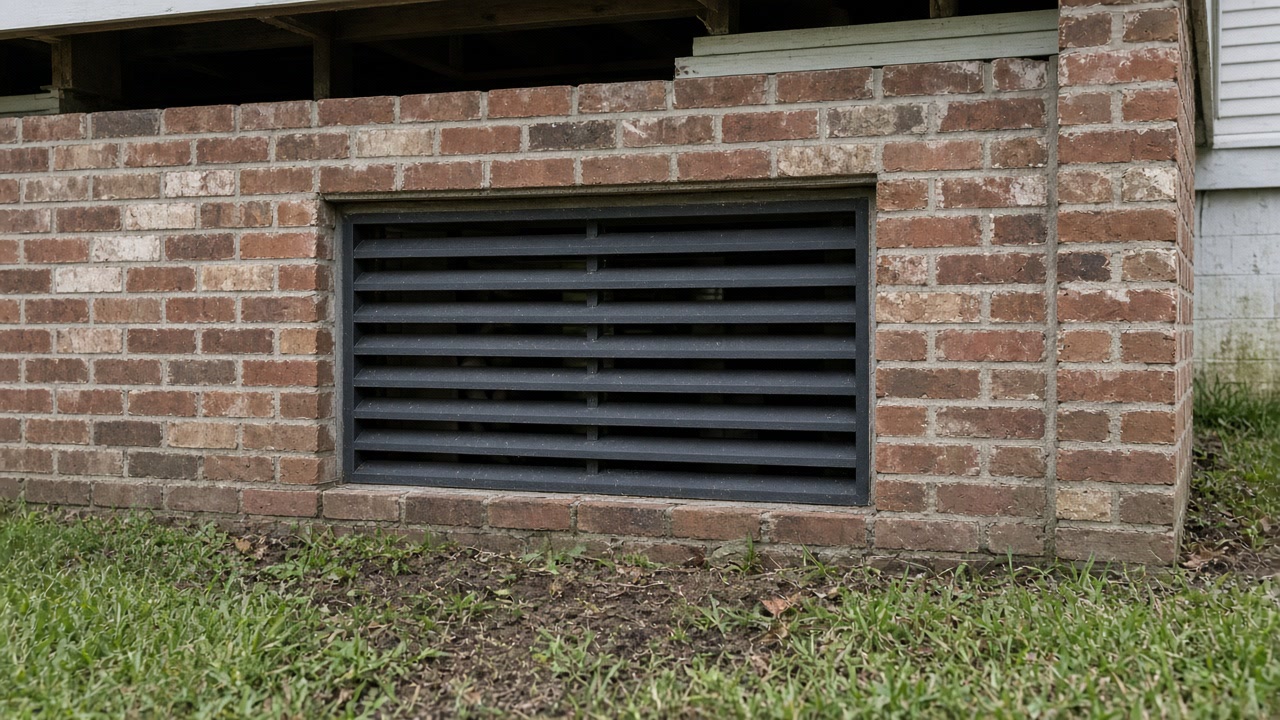
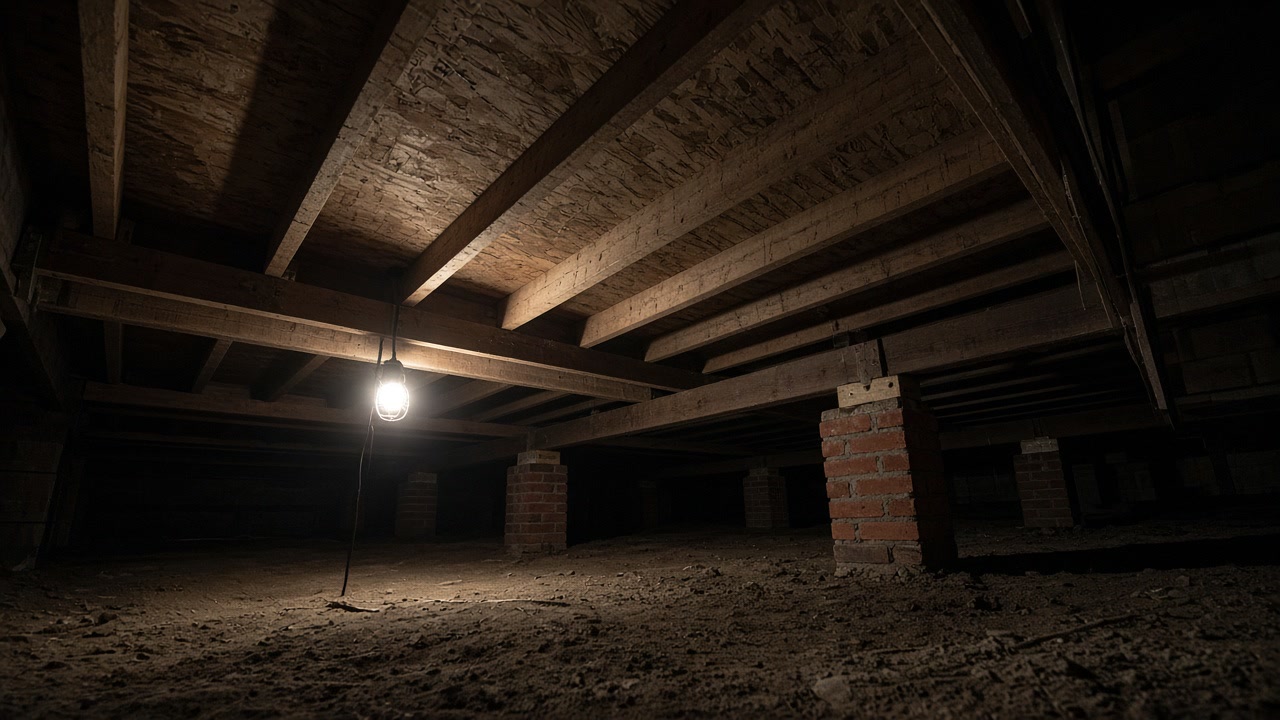
- Under the house: the crawl space or open pier space, the joists and subfloor above it, the ground cover, the ducts running through it, and the foundation openings feeding it warm outdoor air
- The air conditioning treated as a suspect rather than a bystander: condensate pans and lines, duct and plenum insulation, supply registers set in exterior walls, and a system sized so it cools the house without ever running long enough to dry it
- Small inspection openings cut where the reading says to cut them, because in this climate the growth is usually on the cavity side of the finish rather than on the face of it
- Measuring the affected area, since square footage is what separates an afternoon with a bucket from a contract, and the EPA's own ten square foot line sits inside that range
- Air or surface sampling ordered only where a number would change what you do next, which is not most visits and which two federal agencies say out loud
- A written scope a removal contractor can price against: quantities room by room, a method against each, how far containment has to reach, the repair that stops the water, and the check that ends the job
- Records assembled for the reason you are asking: your own decision, a buyer, a lender, an insurer, a landlord or a tenant, with the address's federal repeat loss and claim record pulled where one exists
- Verification once the removal is finished, with the space re-read, re-photographed and signed off by a party that did none of the cutting
Why two New Orleans houses need different visits
Two houses on the same street can need completely different visits. What moves it is what the house stands on, what somebody put on the inside of the exterior wall, and which month you are asking in.
Whether the house is raised over an open space or sits on a slab
The two foundations this metro is built on fail in ways that share no symptoms. On a raised house the federal building science guidance is explicit that in a humid climate the vents do not dry the space, they let warm outdoor air in to condense on joists that the air conditioning above is holding cooler, so the smell arrives long before any stain does. On a slab the plumbing is cast into the concrete and a leak wicks up into the bottom plate, showing as a mark a foot or more from the actual break. Knowing which one you have, before anyone arrives, changes where the visit starts.
What is on the room side of the exterior wall
The Building America Solution Center lists vinyl wall paper alongside polyethylene film and aluminum foil as a Class I vapor retarder, 0.1 perm or less, and the LSU AgCenter tells Louisiana homeowners plainly that the inside face of a wall here should be as permeable as possible: no vinyl wallcovering, no oil-based interior paint, no interior vapor barrier on the insulation. If one of those is on your exterior wall, it is a probable cause, and it is checkable in ten minutes with a utility knife.
The month you are asking in
The mean dew point at the airport station is at or above 60.8F from April through October and peaks at 75.2F in July. Air conditioning season and condensation season are the same season here, so a wall inspected in January is being seen at the one time of year it is least likely to tell the truth. If the smell is a summer smell, say so, because that alone narrows the mechanism.
When the house was built
31.4 percent of New Orleans housing units were built in 1939 or earlier, against 6.1 percent statewide, while the median year built runs to 1990 in Mandeville and 1991 in Covington. Pre-war construction here was raised, wood framed and able to dry in both directions until later finishes were applied to it. Newer stock is tighter and leans on its mechanical systems. The same damp patch has a different likely cause in each.
Which side of Lake Pontchartrain the address is on
The USDA soil survey draws a hard line through this metro: delta clays and organic mucks on the south shore, coastal plain fine sandy loams with fragipans and perched water tables around Slidell, Mandeville and Covington. The south shore drains by machine and the North Shore largely by gravity and through the soil, so a wet yard means something different on each side and the drainage remedy that works on one is wrong on the other.
Whether the address has flooded before, and how often
The federal multiple loss property dataset records 24,518 properties across the six parishes this site covers, 9,168 of them in Jefferson Parish and 7,625 in Orleans Parish. Whether a specific address is on that list is a normal and answerable question here, and the answer changes what the report has to cover: a house that has taken water twice is documented differently from one that never has.
Who the report is written for
Louisiana requires a mold remediation contractor to give a written report to each person he performs the work for, but that duty attaches to the remediator and to jobs above the statutory threshold, not to a survey you commission yourself. A report written for your own decision, a report a buyer will read, and a report that has to stand up to an insurer are three different documents. Settling which one you need before anyone comes out costs nothing.
Whether the work behind it is likely to run over $7,500
R.S. 37:2150.1(11) defines a mold remediation contractor as someone whose mold labor and materials exceed seven thousand five hundred dollars. Under that figure, the written report duty and the rule keeping assessment apart from removal reach nobody at all, which is most residential jobs. A rough sense of scale therefore changes what protection the law is giving you, and it is one of the things a survey establishes.
Leaking, or sweating? They look identical
Describe the wall, the room and the month it is worst in. We will tell you whether this needs a survey, a dehumidifier, or nobody at all, and there is no obligation in asking.
From a meter on the windowsill to a scope somebody else can price
Decide what the survey must answer before the visit
Your own decision, a buyer, a lender, an insurer, a landlord or a tenant. The answer changes what has to be measured, what has to be dated, and who the document is addressed to. It costs nothing to settle and it is awkward to fix afterwards.
Check three things yourself with a knife and a flashlight
Lift a corner of any vinyl wallcovering on an exterior wall and look at its back. Pull a batt away from the studs in the attic or under the house and see which way the paper or foil facing turns. Find out whether the exterior walls were painted with an oil-based product. Each of those three is on the federal or the LSU list of what not to put on the inside face of a wall in this climate, and finding one is a cause, not a clue.
Put a hygrometer in the room and read it in August, not January
The EPA asks for indoor relative humidity between 30 and 60 percent and the CDC asks for no higher than 50. A twenty dollar meter settles most arguments about whether a room has a humidity problem, and it gives the survey a number to start from rather than an impression.
Separate a wall that is leaking from a wall that is sweating
Surface temperature, the dew point of the air touching that surface, and the season usually tell them apart within minutes of arriving. They look identical on the finish and they are completely different jobs, one of them frequently costing nothing but a dehumidifier and a stripped wallcovering.
Go under the floor, or to the bottom of the wall above the slab
On a raised house that means the joists, the subfloor, the ground and the foundation openings. On a slab it means the bottom plate, the baseboard and the first foot of drywall, read with a meter rather than looked at, because water travels sideways through concrete before it shows.
Open something small, where the readings say to open it
The condensation forms on the cavity side of a low-permeance layer, so the growth sits on the back of the wallcovering, the back of the drywall or the room side of the insulation. A palm-sized inspection square in the right place answers the question. Chasing the roof does not.
Measure the area and write the scope
Quantities room by room, a method against each, how far containment has to run, the repair outside the room that stops the water, and the check that ends the job. Written so somebody who was never in the house can price it, because that is exactly who reads it next.
Hand the scope to a different firm, and verify at the end
Louisiana makes it a violation for one mold remediation contractor to perform both halves on the same property, and to hold an interest in both entities. The removal goes elsewhere, and the company that wrote the scope is the one that comes back to confirm the work matched it.
What mold assessment looks like

What a survey leaves to others, and when there is no job here
When you may not need this at all
- If the patch is smaller than about ten square feet, roughly three feet by three feet, the EPA's own guidance is that in most cases a homeowner can handle it. You do not need a report to clean a bathroom ceiling, and nobody should sell you one.
- If you can already see the growth and you already know where the water is coming from, sampling mostly buys a name for something you have found. The EPA says that in most cases, where visible growth is present, sampling is unnecessary, and the CDC says it does not recommend mold testing at all. Spend the money on the water.
- If the smell is a July and August smell and clears by November, that is very likely condensation rather than a leak. Close the house, run the air conditioning with a dehumidifier alongside it, and watch a meter for a week. If the room settles under 60 percent and the smell goes, that was the whole problem. Note the local catch: at a 76 percent annual mean relative humidity, and 88 percent at six in the morning, you will not get there by opening a window.
- If there is vinyl wallcovering on the affected exterior wall, lift a corner before you book anything. The LSU AgCenter's position is that no barrier on the inside face beats one on the wrong side, so stripping it is a genuine repair in this climate and not redecorating. Sometimes that single check ends the investigation.
- If you rent, put it in writing to the landlord first and keep a copy. Louisiana exempts an owner's own staff from mold remediation licensure, so work already done in your unit by the building's maintenance crew carried no license requirement, no written report duty and no separation rule. That is worth knowing before you pay for anything yourself.
What is out of scope
- The removal itself. It goes to a different firm, and that separation is the reason this survey exists as something you can buy on its own.
- The repair that stops the water: a plumber on a line under the slab, a roofer, grading and downspouts, duct or air handler work, or the dehumidification equipment a house may simply need.
- Structural and foundation engineering opinions. The ground under this metro moves unevenly rather than uniformly, so what a slab or a pier line is doing is an engineer's question about your address, not a moisture surveyor's.
- Asbestos and lead surveys. Separate disciplines with their own rules, and on pre-war stock they belong before any demolition rather than after it.
- Any opinion on health, symptoms or diagnosis.
- A clean bill for the air. The EPA states that no federal limits have been set for mold or mold spores, so there is no standard a sample could pass. The report sets down readings, measurements and dated photographs, nothing graded.
- Interpreting your insurance cover, or negotiating a claim with the adjuster for you.
- Legal advice. The report is a record of fact. Using it with a seller, a landlord or an insurer is a conversation for your own attorney.
Assessments arranged across the New Orleans metro
- Mold Assessment in New Orleans
- Mold Assessment in Metairie
- Mold Assessment in Kenner
- Mold Assessment in Gretna
- Mold Assessment in Harvey
- Mold Assessment in Marrero
- Mold Assessment in Chalmette
- Mold Assessment in Slidell
- Mold Assessment in Terrytown
- Mold Assessment in Westwego
- Mold Assessment in River Ridge
- Mold Assessment in Arabi
- Mold Assessment in Belle Chasse
- Mold Assessment in Mandeville
- Mold Assessment in Covington
- Mold Assessment in Laplace
What owners ask before booking an assessment
Does Louisiana license mold inspectors?
No. The state contractor licensing law creates one mold classification and it is mold remediation. There is no state license, registration or state credential for a mold assessor or a mold inspector, so anyone advertising one is describing something Louisiana does not issue. What the law does give you is better than a badge: R.S. 37:2158(A)(19) requires a written report from a remediation contractor, forbids false or unfounded opinions and reports, and forbids one company doing both the assessment and the removal on the same property. And the board publishes a free Contractor Search at https://arlspublic.lslbc.louisiana.gov/Public/DetailedSearch/ where you can check any name yourself.
Can the firm that surveys the house also do the removal?
Not on the same property, once the removal work exceeds seven thousand five hundred dollars. R.S. 37:2158(A)(19)(c) makes performing both a violation for a mold remediation contractor, and subsection (d) makes it a violation to own an interest in both the assessing entity and the removing entity, so two names on two vans is not two companies. Below the threshold the statute does not reach the person doing the work, which is why we keep the two halves in different hands at every price rather than only where we are required to.
The growth is visible. Do I still need a lab test?
Usually not, which is an awkward thing for us to write down. The EPA says that in most cases, where visible mold growth is present, sampling is unnecessary, and the CDC does not recommend mold testing. No laboratory number tells you the thing that actually moves the price, which is where the water is arriving from. Sampling earns its fee in three situations: a smell nobody can locate, water of unknown origin, or a buyer, an insurer or a court that needs the condition recorded on paper.
The wall is sweating in July. Is that mold?
It is the start of it, and it is the most common thing we talk people out of paying to remove. The mean dew point at the airport is 75.2F in July, and a cooled house holds its interior surfaces somewhere near 72F to 76F, so the average summer day is already at the condensing point with no leak and no rain involved. The federal guidance describes the rest: vapor migrating inward condenses on a cool, impermeable surface with no way to dry back into the room. If there is vinyl wallcovering, oil paint or a foil facing on that wall, the water is landing behind it.
What is actually in the report?
Rooms, measured areas and the materials involved. Dated moisture readings and surface temperatures. Photographs tied to locations. The direction the water is arriving from and its likely source, stated as a leak, a condensing surface, or both. Any fix needed beyond the room itself for the work to hold. For each area, how it should be removed and how tightly it must be sealed off. And the check that should be used to call the removal finished. It is written to be read by somebody who was never in the house, because that is who reads it next.
My job will be small. Does any of the law still protect me?
Less than most people assume, and it is worth saying plainly. Louisiana defines a mold remediation contractor as someone whose mold labor and materials exceed seven thousand five hundred dollars, so under that figure there is no license to hold, no statutory written report and no rule keeping the assessment apart from the removal. That is the ordinary residential job. The legislature clearly expected the line to be gamed as well: R.S. 37:2158(B)(1) says any division of a contract into parts that avoids the need for a license is disregarded and the parts treated as one. If a single job is offered to you as two smaller invoices, you have been told what it is really worth.
Show us what you are looking at
A few lines about the wall, the smell and why you are asking is enough. A person reads it and writes back with what it actually needs.