
Mold in a New Orleans Rental: What Tenants and Landlords Should Know
Whoever controls the water, and that is the argument worth having in writing rather than an argument about mold. Start there, because the one thing Louisiana law is clear about will surprise most tenants: R.S. 37:2157(A)(17) exempts a landlord's own managing agent or employees from mold remediation licensure entirely, so if the work in your unit was handled in-house, no license requirement, no written report duty and no separation rule applied to it.
Already know you need someone out? Call (315) 640-3590.
Describe the damp, and leave the mold out of it
Mold is arguable. Water is not. A message saying there is mold in the bathroom invites a disagreement about how much and whose fault; a message saying the ceiling under the upstairs shower has been damp since the fourteenth, with a photograph and a date, is a record of a building fault. The EPA's own framing supports you here: the way to control indoor mold growth is to control moisture, and material dried within 24 to 48 hours will in most cases not grow mold. So the clock and the cause are both about water, and both are things a landlord can act on. Put it in writing, keep the dates, photograph the source rather than only the stain, and note when you reported it. Everything else in this guide is easier if that record exists.
Your landlord's own maintenance crew is exempt from the licensing rules
R.S. 37:2157(A)(17) exempts from mold remediation licensure a residential property owner performing the work on his own property, and an owner or tenant, or a managing agent or employee of an owner or tenant, performing it on property they own or lease. The exemption falls away only where that agent or employee engages in the business of performing mold remediation for the public. In plain terms, if the building's own staff dealt with it, the statute's duties never attached: no license was required, no written report was owed, and the rule keeping the assessment separate from the removal did not apply. This is not a reason to assume the work was poor. It is a reason to ask, in writing, what was found, what was removed and what was done about the source, because those are the things a contractor above the threshold would have been legally obliged to put on paper.
What changes the moment an outside contractor is brought in
If the landlord hires a firm and the job exceeds seven thousand five hundred dollars in labor and materials, that firm is a mold remediation contractor under R.S. 37:2150.1(11) and the duties switch on. It must provide a written report to each person it performs the services for, it may not render false, deceptive, misleading or unfounded opinions, it may not perform both the assessment and the remediation on the same property, and it may not own an interest in both entities. As a tenant you are usually not the person paying, so the report duty runs to the landlord rather than to you. Ask for a copy anyway. A landlord with nothing to hide has no reason to refuse, and the report is the document that tells you whether the source was found or only the surface was cleaned.
About half the households in Gretna, Terrytown and New Orleans rent
This is not a niche situation in this metro. Renter share of occupied homes runs from 20.2 percent in Belle Chasse and 22.5 percent in Laplace up to 48.8 percent in New Orleans, 50.8 percent in Terrytown and 51.2 percent in Gretna, with Harvey close behind at 47.3 percent. Gretna and Terrytown are also very different buildings: Gretna has 8,352 units with 16.5 percent built in 1939 or earlier, the highest pre-war share in Jefferson Parish, while Terrytown's 9,723 units went up almost entirely across three decades, 2,478 in the 1960s, 2,744 in the 1970s and 2,173 in the 1980s. In a single-generation subdivision like Terrytown, your neighbors' units were built to the same specification as yours, so if several report the same symptom, that is evidence about the assembly rather than coincidence and it is worth collecting.
On a shotgun double the water may be entering next door
New Orleans has 195,552 housing units and only 46.0 percent of them are single family detached. 28,986 sit in two unit buildings and 19,407 are single family attached, the doubles and row forms that share a party wall, and 31.4 percent of the whole stock dates from 1939 or earlier, against 6.1 percent statewide. If you rent half a double, the water behind your stain can be arriving on the other side of a wall you have no access to. That changes who has to act: not your landlord alone, and possibly not your side of the building at all. It is also the commonest reason a repair on one side gets done twice. Say it explicitly when you report the problem, because an assessor who is told the building is attached will look at the party wall and one who is not told will look at your bathroom.
Is it the house itself, or how the rooms are run
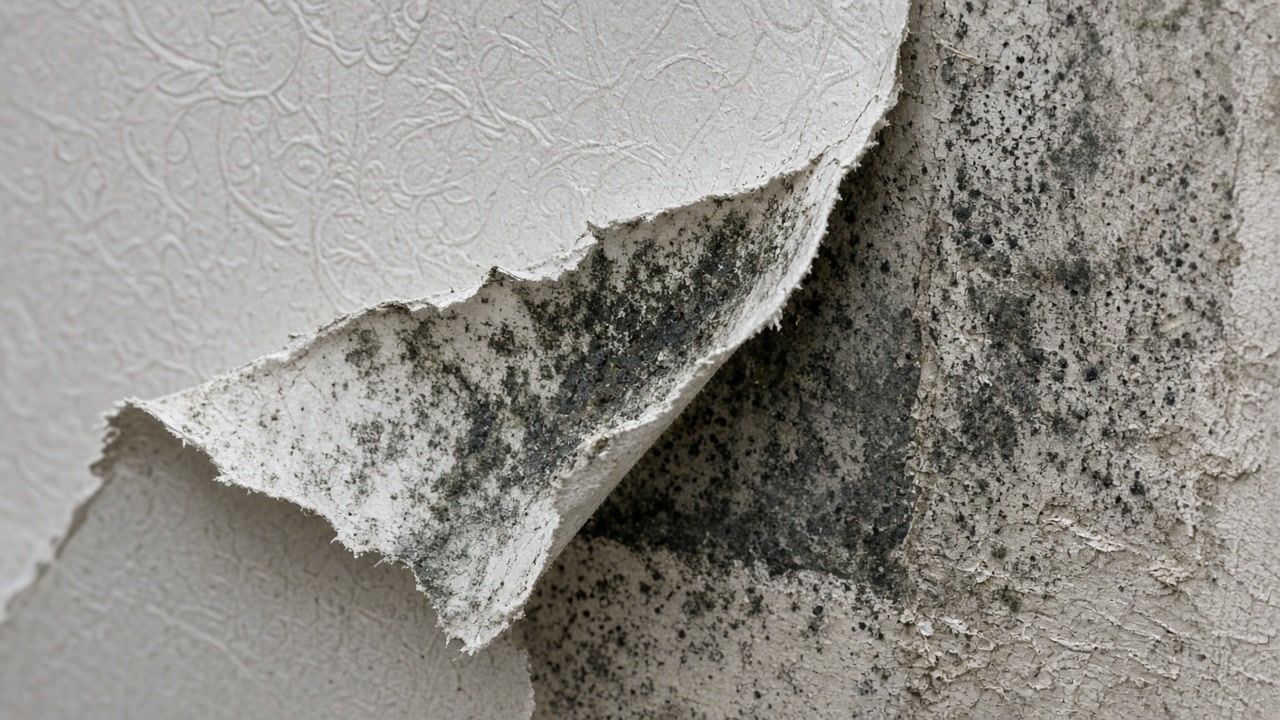
It is a fair question and it deserves a fair answer, because the honest answer in this climate is usually the building. The EPA's target is 30 to 60 percent indoor relative humidity, the CDC's ceiling is 50 percent, and reaching either means venting bathrooms and dryers outside and running exhaust fans. Those are things a tenant can do and should. But NOAA puts the mean dew point at 75.2F in July, at or above the temperature a cooled unit holds its walls at, and four finishes turn an exterior wall into a condensing plane here: vinyl wallpaper, oil-based interior paint, polyethylene sheet inside the studs, and faced batt insulation with the facing toward the room. None of those is a tenant's decision. If there is vinyl wallcovering on an exterior wall of your unit, the growth on the back of it is a building fault with a date of installation, and a hygrometer reading taken in August is the evidence that settles the argument.
Which authority holds the permit file for your address
It is worth knowing who the building answers to, and it is not always the name on your mail. Five of the sixteen places in this service area are Census designated places with no municipal government of their own, and Metairie, Harvey, Marrero, River Ridge, Terrytown, Chalmette, Arabi, Belle Chasse and Laplace all fall to their parish for permits, inspections and floodplain rules. New Orleans is the simplest case in the metro: the city and Orleans Parish are the same jurisdiction, with one permit office and one floodplain administrator for every address. The City states that building permits come from the Department of Safety and Permits, that a permit is needed to alter, repair or demolish part of a building, and that interior painting and papering is exempt. So a repainted wall leaves no trace, and a wall that was opened up should have a permit record behind it. If you are asking whether real work was done, that is where the paper is.
If you are the landlord reading this
The separation rule is a protection for you as much as for a tenant. Above $7,500 you cannot lawfully have one firm both assess and remediate, and you cannot use two firms you own an interest in, so the structure the law requires also happens to be the one that stops you paying for a scope written by the person who benefits from its size. Below the threshold nothing forces it and the same logic still applies. Check any firm on the board's public Contractor Search, which takes a name, license number, city, parish and qualifying party and returns only currently active licenses. And read a quote that lands just under the line carefully: R.S. 37:2158(B)(1) disregards any division of a contract made to avoid a licensing threshold and treats the parts as one, which tells you that pattern was anticipated. Get the written report either way and keep it, because it is the document that answers the next tenant's question.
Ask whether the building has flooded before
This is a normal and answerable question in this metro, and it changes what a damp wall probably means. The federal multiple loss property dataset records 24,518 properties across these six parishes: 9,168 in Jefferson, 7,625 in Orleans, 3,853 in St. Tammany, 2,539 in St. John the Baptist, 858 in St. Bernard and 475 in Plaquemines. Orleans Parish alone has 127,238 flood insurance claims on record since the program began. A building that has taken water repeatedly has usually had material replaced repeatedly, sometimes well and sometimes not, and knowing that before you sign a lease or price a repair is worth more than any inspection of the visible surface. The insurer already knows. Ask for it in writing.
What you do not need to hire anyone for
A lot of this. If the affected area is under about 10 square feet, roughly three feet by three feet, the EPA says a homeowner can in most cases handle it themselves, and the same practical logic applies in a rented unit once the landlord has agreed to it. You almost certainly do not need testing: the EPA states that where visible growth is present, sampling is in most cases unnecessary, and the CDC states that it does not recommend mold testing, so paying a laboratory to confirm what you can see is money that would be better spent finding the water. What is worth buying, when the argument has stalled or the area is large, is an independent moisture assessment with the readings and the extent written down, from a firm that is not the one selling the removal. That is what we arrange, and we keep the two in different hands at every price. Send us the details and we will start there.
Sources used in this guide

Louisiana R.S. 37:2157(A)(17) exempts from mold remediation licensure a residential property owner who performs mold remediation on his own property, and an owner or tenant, or a managing agent or employee of an owner or tenant, who performs mold remediation on property owned or leased by the owner or tenant, with that exemption not applying if the managing agent or employee engages in the business of performing mold remediation for the public.
Source: Louisiana State Licensing Board for Contractors, Contractors Licensing Law and Rules and Regulations, effective August 1, 2022, accessed 2026-09-22
Louisiana R.S. 37:2158(A)(19)(a) makes it a violation for a mold remediation contractor to fail to provide a written report to each person for whom he performs such services for compensation.
Source: Louisiana State Licensing Board for Contractors, Contractors Licensing Law and Rules and Regulations, effective August 1, 2022, accessed 2026-09-22
Louisiana R.S. 37:2158(A)(19)(c) makes it a violation for a mold remediation contractor to perform both mold assessment and mold remediation on the same property.
Source: Louisiana State Licensing Board for Contractors, Contractors Licensing Law and Rules and Regulations, effective August 1, 2022, accessed 2026-09-22
Louisiana R.S. 37:2158(A)(19)(d) makes it a violation for a mold remediation contractor to own an interest in both the entity which performs mold assessment services and the entity which performs mold remediation services on the same property.
Source: Louisiana State Licensing Board for Contractors, Contractors Licensing Law and Rules and Regulations, effective August 1, 2022, accessed 2026-09-22
Louisiana R.S. 37:2150.1(11) defines the regulated person by the size of the job: a mold remediation contractor means any person who engages in removal, cleaning, sanitizing, demolition, or other treatment, including preventative activities, of mold or mold-contaminated matter that was not purposely grown at that location and where the costs for such labor and materials exceed seven thousand five hundred dollars. Mold remediation applies only to the regulation of mold-related activities that affect indoor air quality and does not apply to routine cleaning when not conducted for the purpose of mold-related activities intended to affect indoor air quality.
Source: Louisiana State Licensing Board for Contractors, Contractors Licensing Law and Rules and Regulations, effective August 1, 2022, accessed 2026-09-22
Louisiana R.S. 37:2158(B)(1) provides that in determining the value of a project, any division of a contract or scope of work into parts which would avoid the necessity of a license to bid, contract, or perform the work, will be disregarded, and the divided parts of the contract or scope of work will be treated as one contract or scope of work for purposes of determining whether a license is required.
Source: Louisiana State Licensing Board for Contractors, Contractors Licensing Law and Rules and Regulations, effective August 1, 2022, accessed 2026-09-22
Louisiana R.S. 37:2158(A)(19)(b) makes it a violation for a mold remediation contractor to render, submit, subscribe, or verify false, deceptive, misleading, or unfounded opinions or reports.
Source: Louisiana State Licensing Board for Contractors, Contractors Licensing Law and Rules and Regulations, effective August 1, 2022, accessed 2026-09-22
The board publishes a free public contractor search that can be queried by contractor name, license number, city, parish, type of contractor and qualifying party, and returns only contractors whose license or registration is currently active. The page carries the board's own caution that the information is provided as a courtesy and may not reflect recent changes or updates.
Source: Louisiana State Licensing Board for Contractors, contractor search, accessed 2026-09-22
Renter share of occupied homes across this service area ranges from 20.2 percent in Belle Chasse and 22.5 percent in Laplace to 48.8 percent in New Orleans, 50.8 percent in Terrytown and 51.2 percent in Gretna.
Source: United States Census Bureau, American Community Survey 2020-2024 five year estimates, accessed 2026-09-22
Harvey has 9,253 housing units with a median year built of 1975. 61.8 percent predate 1980 and only 231 units, 2.5 percent, predate 1940. Renters occupy 47.3 percent of occupied homes, the fourth highest share in this service area.
Source: United States Census Bureau, American Community Survey 2020-2024 five year estimates, accessed 2026-09-22
Gretna has 8,352 housing units with a median year built of 1966, but 1,378 of them, 16.5 percent, were built in 1939 or earlier, the highest pre-war share in Jefferson Parish and second in this service area only to New Orleans. 73.1 percent of the stock predates 1980 and 51.2 percent of occupied homes are rented.
Source: United States Census Bureau, American Community Survey 2020-2024 five year estimates, accessed 2026-09-22
Terrytown has 9,723 housing units with a median year built of 1976, built out almost entirely in three decades: 2,478 units from the 1960s, 2,744 from the 1970s and 2,173 from the 1980s. Only 141 units, 1.5 percent, predate 1940 and 50.8 percent of occupied homes are rented.
Source: United States Census Bureau, American Community Survey 2020-2024 five year estimates, accessed 2026-09-22
New Orleans has 195,552 housing units with a median year built of 1960. 61,327 of them, 31.4 percent, date from 1939 or earlier and 73.7 percent predate 1980. Only 46.0 percent of the stock is single family detached: 28,986 units sit in two unit buildings and 19,407 are single family attached, the shotgun doubles and row forms that share a party wall.
Source: United States Census Bureau, American Community Survey 2020-2024 five year estimates, accessed 2026-09-22
31.4 percent of New Orleans housing units, 61,327 of 195,552, were built in 1939 or earlier. The Louisiana figure is 6.1 percent and the national figure is 11.7 percent. No other place in this service area comes close: Gretna is next at 16.5 percent, then Arabi at 11.4 percent.
Source: United States Census Bureau, American Community Survey 2020-2024 five year estimates, accessed 2026-09-22
The city of New Orleans and Orleans Parish are coextensive. The American Community Survey returns identical housing figures for the two geographies: 195,552 units, median year built 1960, 61,327 units built in 1939 or earlier.
Source: United States Census Bureau, American Community Survey 2020-2024 five year estimates, accessed 2026-09-22
Five of the sixteen places in this service area are Census designated places with no municipal government of their own. The Census Bureau's 2024 gazetteer records Metairie, Harvey, Marrero, River Ridge and Terrytown as CDPs, along with Chalmette, Arabi, Belle Chasse and Laplace. New Orleans, Kenner, Gretna, Westwego, Slidell, Mandeville and Covington are incorporated cities.
Source: United States Census Bureau, 2024 Gazetteer Files, Places, Louisiana, accessed 2026-09-22
The City of New Orleans states that building permits are issued by the Department of Safety and Permits, that a permit is needed to construct, enlarge, alter, repair, move, demolish, or change the occupancy of a building or structure, and that interior painting, papering and similar finish work is exempt. The guide directs anyone uncertain about whether a permit is needed to call the Building Division.
Source: City of New Orleans, Guide to Building Permits, accessed 2026-09-22
The EPA states that there is no practical way to remove every mold spore from an indoor space, and that the way to control indoor mold growth is to control moisture.
Source: United States Environmental Protection Agency, accessed 2026-09-22
The EPA states that wet or damp building materials and furnishings should be cleaned and dried within 24 to 48 hours to prevent mold growth, and that if wet or damp materials or areas are dried 24 to 48 hours after a leak or spill happens, in most cases mold will not grow.
Source: United States Environmental Protection Agency, accessed 2026-09-22
The EPA advises reducing indoor humidity to between 30 and 60 percent to decrease mold growth, by venting bathrooms, dryers and other moisture-generating sources to the outside, using air conditioners and dehumidifiers, increasing ventilation, and using exhaust fans when cooking, dishwashing and cleaning.
Source: United States Environmental Protection Agency, accessed 2026-09-22
The CDC advises keeping humidity levels in your home as low as you can, no higher than 50 percent, all day long.
Source: Centers for Disease Control and Prevention, About Mold, accessed 2026-09-22
The EPA advises that if the moldy area is less than about 10 square feet, less than roughly a three foot by three foot patch, in most cases a homeowner can handle the job themselves.
Source: United States Environmental Protection Agency, accessed 2026-09-22
Where mold growth can already be seen, EPA guidance says sampling is in most cases unnecessary.
Source: United States Environmental Protection Agency, accessed 2026-09-22
The CDC states that it does not recommend mold testing.
Source: Centers for Disease Control and Prevention, About Mold, accessed 2026-09-22
Four things become the condensing plane on an exterior wall in this climate, and all four are on the federal and university lists of what not to do in a warm-humid zone: vinyl wallpaper, which the Building America Solution Center classes at 0.1 perm or less; oil-based interior paint, which the LSU AgCenter names; polyethylene sheet on the interior face of the studs; and foil-faced or kraft-faced batt insulation installed with the facing toward the room.
Source: Pacific Northwest National Laboratory, U.S. Department of Energy Building America Solution Center, accessed 2026-09-22
The NOAA thirty year normals for 1991 to 2020 at the New Orleans airport station put the mean dew point at 75.2F in July and 75.1F in August. Dew point is the temperature at which the air in question starts giving up its water, so on the average July day the outdoor air here will condense on any surface held below about 75F.
Source: NOAA National Centers for Environmental Information, 2023 Local Climatological Data Annual Summary with Comparative Data, NEW ORLEANS, LOUISIANA (KMSY), WBAN 12916, accessed 2026-09-22
Across the six parishes in this service area the OpenFEMA National Flood Insurance Program Multiple Loss Properties dataset records 24,518 properties: 9,168 in Jefferson Parish, 7,625 in Orleans Parish, 3,853 in St. Tammany Parish, 2,539 in St. John the Baptist Parish, 858 in St. Bernard Parish and 475 in Plaquemines Parish.
Source: Federal Emergency Management Agency, OpenFEMA dataset NFIP Multiple Loss Properties, data as of August 2, 2026, accessed 2026-09-22
Orleans Parish has 127,238 National Flood Insurance Program claims on record. The dataset covers claims from the start of the program and is redacted to protect individual policyholders.
Source: Federal Emergency Management Agency, OpenFEMA dataset FIMA NFIP Redacted Claims, data as of June 1, 2026, accessed 2026-09-22
Services this guide relates to
Need someone to look at it?
Send the details and we will come back to you.